The Very Hungry Caterpillar Math Game
A narrative-based iPad game design introducing percentages and proportional reasoning to children ages 5–7 through the world of Eric Carle designed as part of a Games and Simulations Class at NYU
ROLE
UI/UX Designer, Researcher, Game Mechanics Designer
TEAM
3 designers
DURATION
8 weeks · Oct – Nov 2024
CLASS
Games & Simulations in Education (NYU)
TOOLS
Figma · Playtesting · Adobe Express
PLATFORM
iPad
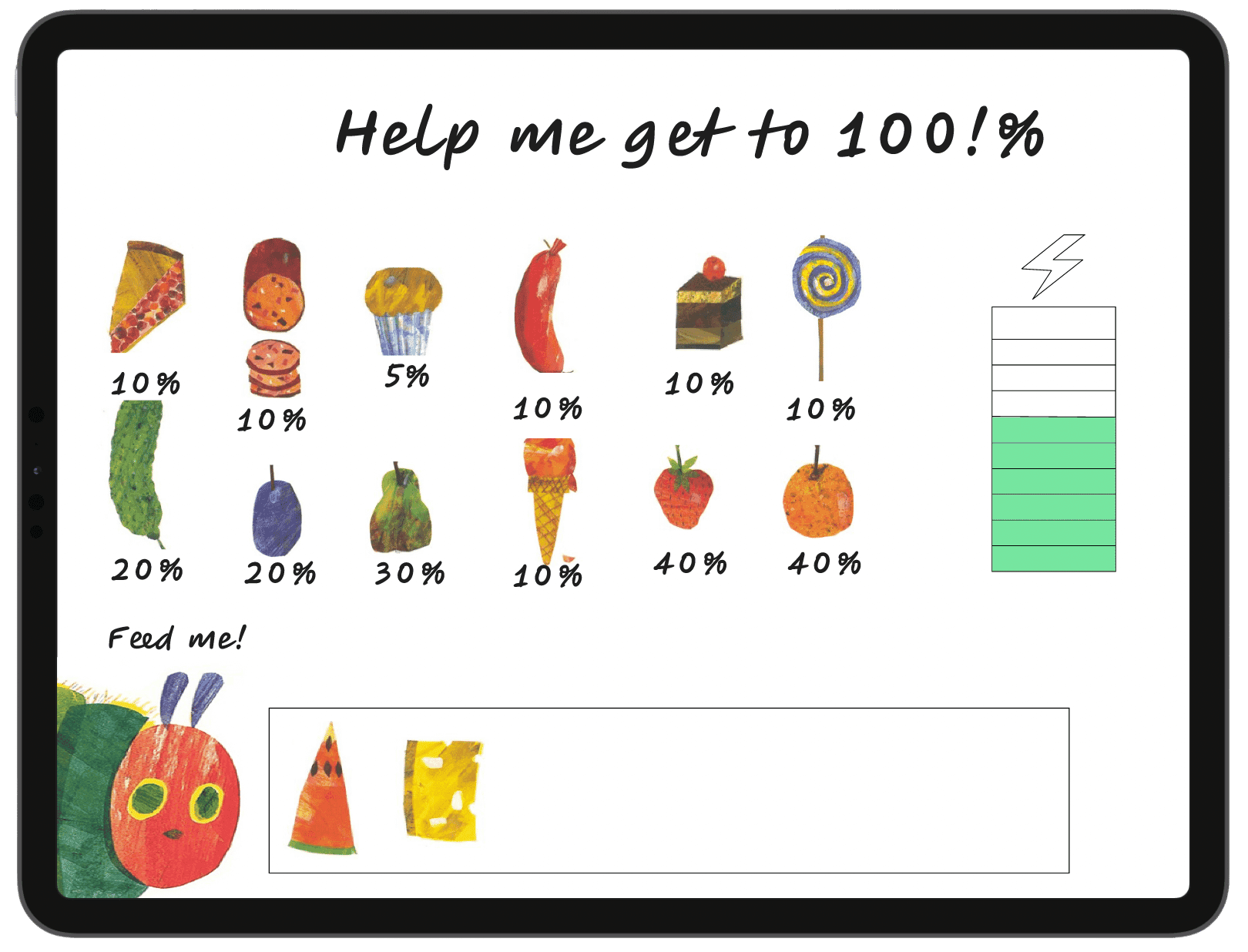
THE PROBLEM
Most early-math apps and narrative games work in isolation. There are few games for preschool students that combine narrative with teaching math concepts like percentages.
THE OUTCOME
A hi-fi Figma prototype of a three-level math game, combining narrative with teaching percentages to children aged 5-7 years, designed as an Ipad game from lo-fi sketches through two rounds of playtesting.
THE IMPACT
A classroom-ready concept and playtested game prototype for 5–7 year olds that translates a beloved picture book into a percentage-reasoning game.
How this game came to be
The game started as a literacy concept and evolved into a narrative-based math game. A market analysis found no apps combined mathematical learning with narrative from children's media in a truly free-play format.
Percentages appear in Grade 4 (ages 8–10) — we saw an opportunity to build early, informal exposure so the concept feels familiar rather than foreign when it arrives in school.
"A gap existed for merging educational content with popular narratives from children's media. We built something to fill it."
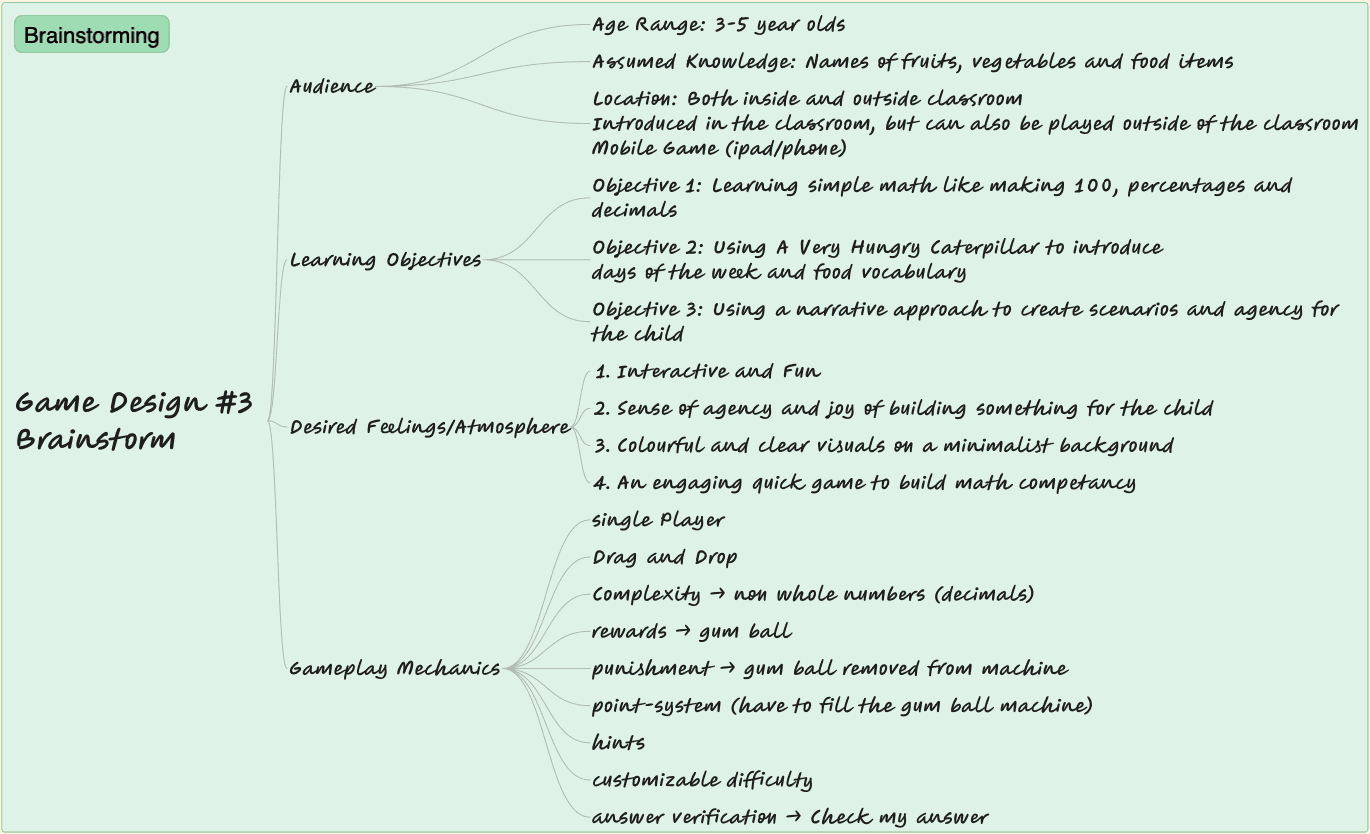
Conceptualized as free-play exploration game for children
Market analysis: no apps successfully blended mathematical learning with narrative from children's media in a playful, non-instructional way
Designed for informal contexts: home, libraries, after-school programs, and on-the-go, requiring short, self-contained rounds and offline capability
2D aesthetic deliberately mirrors Eric Carle's hand-painted collage style, a visual language children already recognize and trust
Learning objectives
LO1 · 📊
Exposure to percentages
Gaining early exposure to percentages in the context of eating — before the formal concept is introduced in Grade 4.
LO2 · ⚖️
Under, over, and just right
Understanding the difference between under-eating, over-eating, and eating just enough — introducing proportional reasoning through a familiar, embodied concept.
LO3 · 🎲
Non-competitive individualized play
The game has no failure state or leaderboard. Children play at their own pace, building confidence rather than anxiety around numbers.
LO4 · ⚡
Food and energy
Gaining exposure to the idea that different foods provide different levels of energy — connecting math to science and real-life intuition.
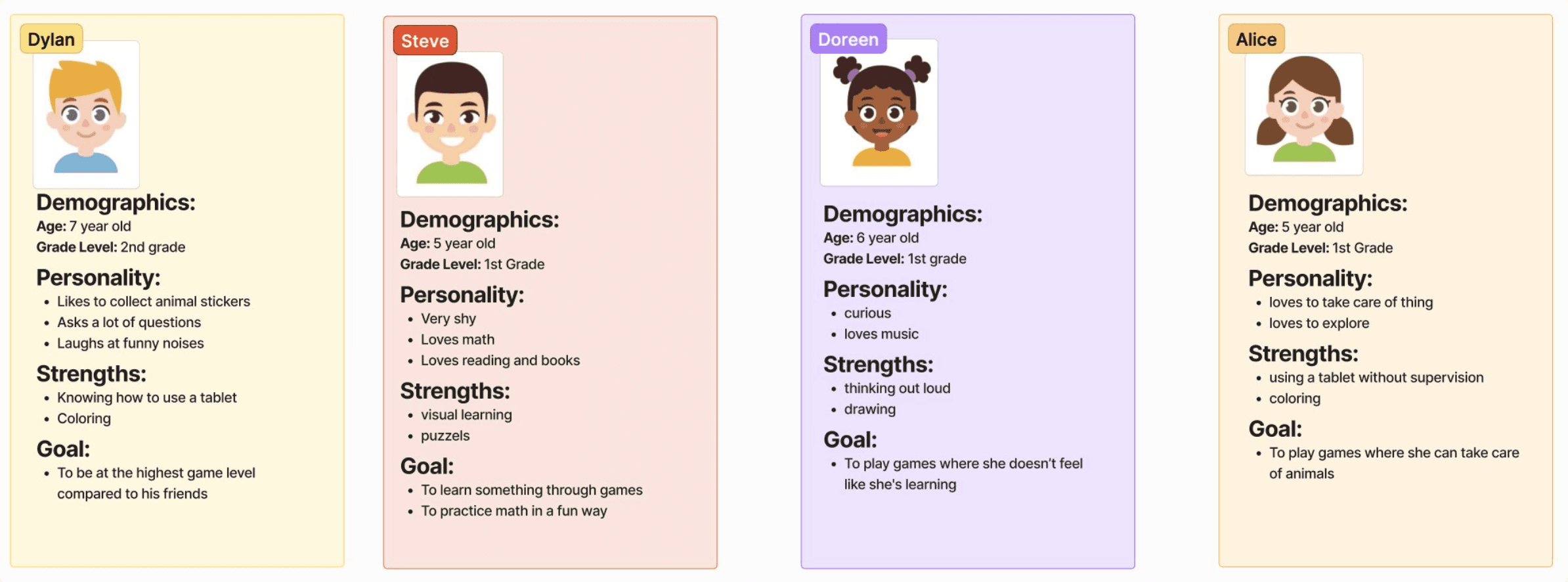
Four learner personas
Our needs assessment identified four primary learner personas (ages 5–7) and one non-learner parent persona. Each shaped different design decisions — from game complexity to the parent-gated difficulty mode.
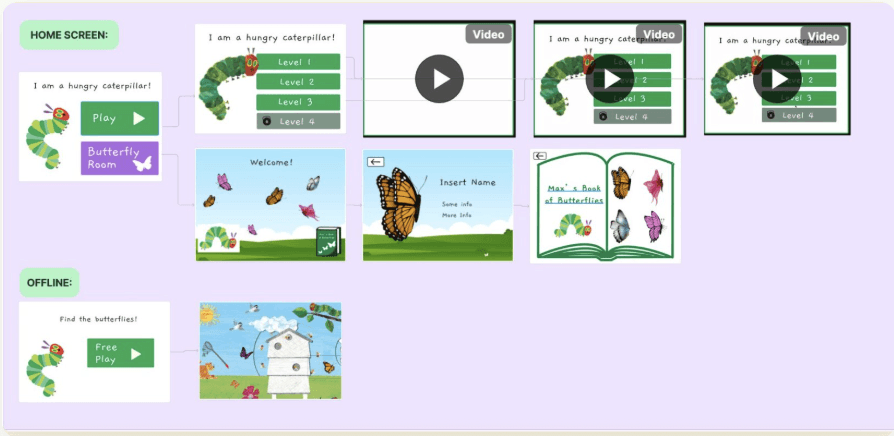
Explore the interactive design
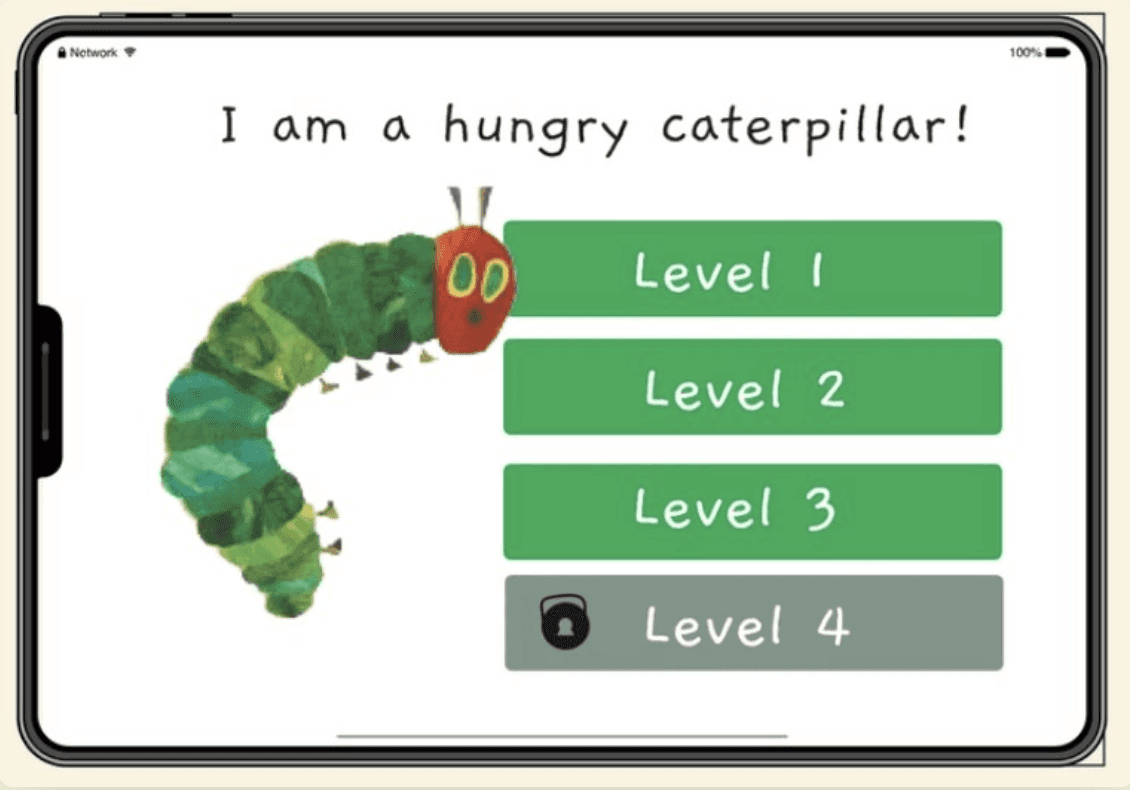
The prototype covers the full player experience: home screen → level select → gameplay with energy meter → butterfly unlock → Butterfly Room → Book of Butterflies. Offline Free Play activates automatically when there's no connection.
From lo-fi to hi-fi across two playtests
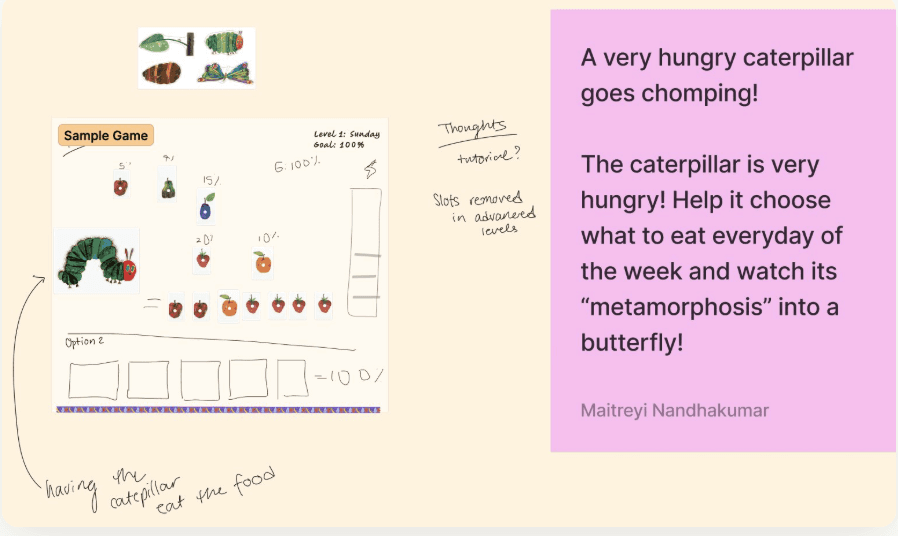
ROUND 01 · ✏️
Lo-fi Proto #1 → Playtest #1
Initial concept tested the core food-feeding loop. Feedback: children needed clearer visual fullness feedback, complexity should increase gradually, and storytelling was a stronger hook than expected — we leaned further into the narrative.
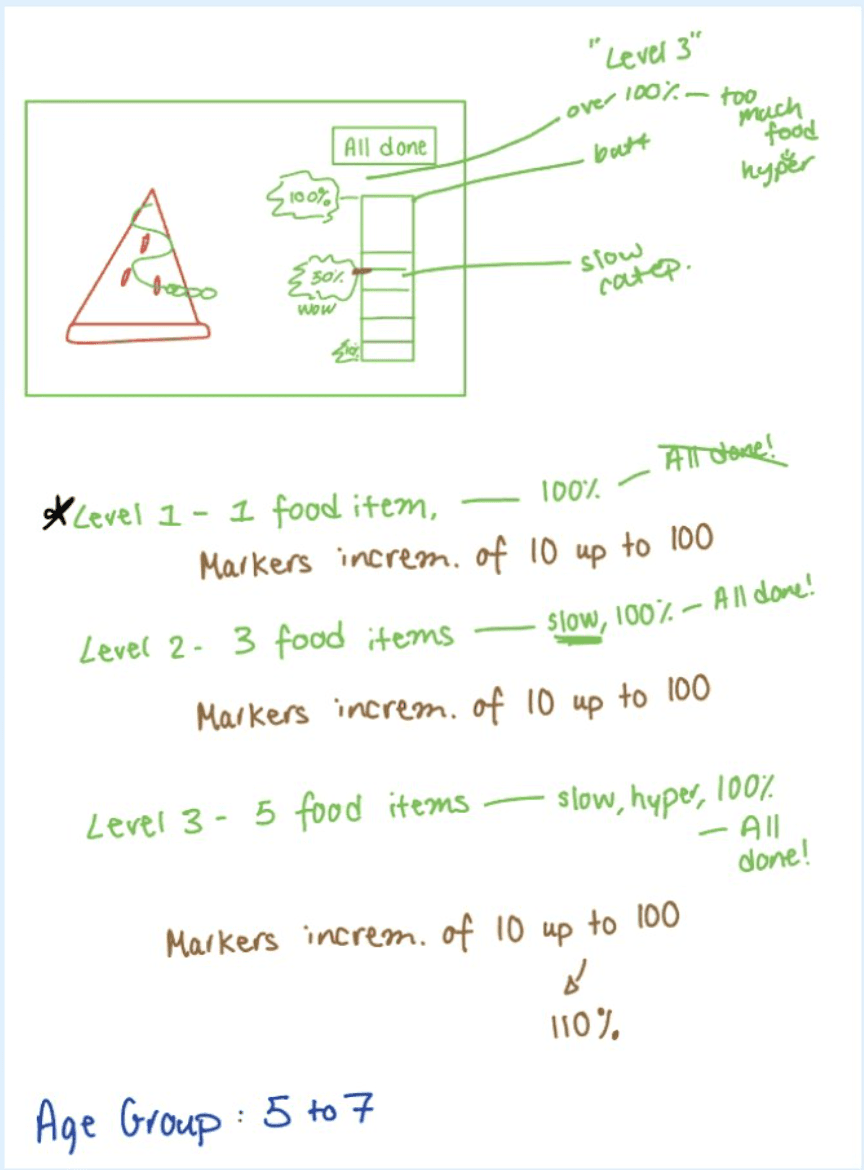
ROUND 02 · 🔁
Lo-fi Proto #2 → Playtest #2
Introduced the "Done" button in Level 2 — players can stop eating before all food is consumed. Real consequence: if the caterpillar doesn't reach 100%, no butterfly unlock. Players try again by choice, not compulsion.
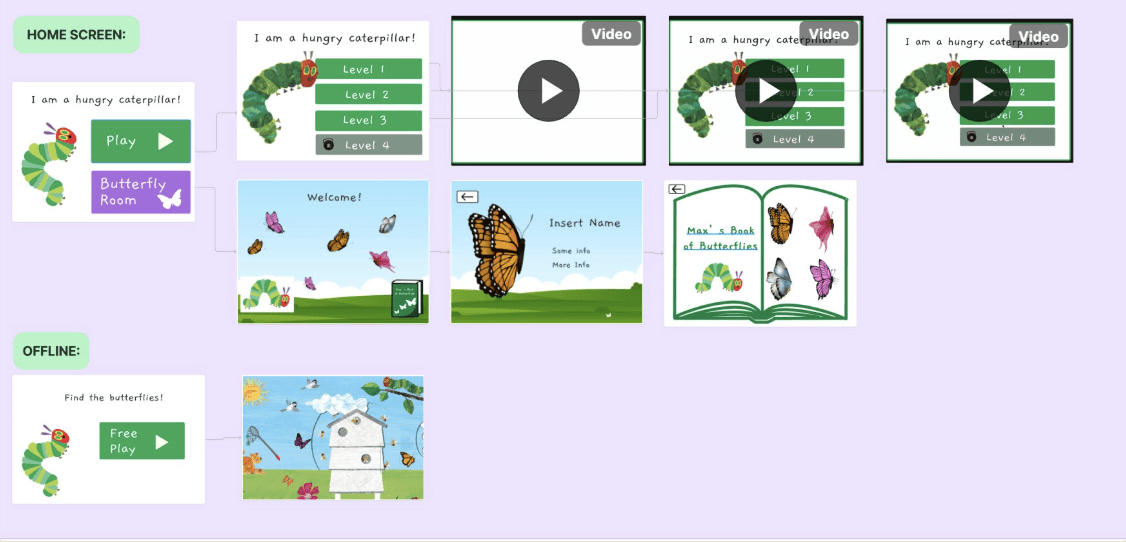
FINAL · 🚀
Final Proto → Final Playtest
Hi-fi with all three levels, full butterfly garden, offline Free Play, and parent gate. Final playtest confirmed the incentive loop: children replayed levels to earn new butterfly colors: the collection mechanic worked.
Three levels, each teaching something new
🍧
Level 1 — Eat the Cheese
Very simple. One food item, percentages at 50% and 100% only. Designed to help players understand the core mechanic: tap food → caterpillar eats → energy bar fills. Level isn't over until all cheese has been eaten.
🍊
Level 2 — Multiple Foods + "Done"
Introduces a "Done" button: players can choose to stop eating before finishing all food on screen. This creates real consequence — if the caterpillar doesn't reach 100%, it doesn't transform into a butterfly. Players must try again.
🍕
Level 3 — Five Foods, Up to 110%
More food options, more complexity. Percentages can exceed 100% — the caterpillar gets hyper/bloated and doesn't become a butterfly. Introduces the idea that over-eating has consequences, adding goal-based strategic thinking.
KEY FEATURES
The incentive system
FEATURE 01 · 🦋
Butterfly Room & Collection Book
Each completed level unlocks a butterfly that lives in the Butterfly Room. Players can click any butterfly to learn more, or flip through their personal Book of Butterflies. Butterflies take on the colors of the foods the caterpillar ate — making every child's collection unique.
FEATURE 02 · 🎮
Offline Free Play
When the device is offline, Free Play activates automatically — children catch butterflies in the garden using a number-count mechanic. Designed like the Google Dino game: always available, no internet required. Future: add mini-games and competitive options.
FEATURE 03 · 👨👩👧
Customizable Levels (Parent Gate)
A "Learn with Me" tab — unlocked by solving a simple arithmetic question (e.g. 56÷11=?) — lets the adult supervisor adjust percentage increment levels to 5, 10, 15 ... 50. This tailors difficulty to the child's pace and expands playtime without redesigning the game.
LEARNING THEORY
The research behind the design
PIAGET: COGNITIVE DESIGN
• Pre-operational stage (ages 2–7): symbolic play, one dimension at a time
• Drag-and-drop food = symbolic representation of feeding
• Butterfly transformation = symbolic understanding of growth
• Open-ended food combos: intuitive, not logical problem-solving
PARTON: THEORY OF PLAY
• Parallel play: children interact individually, making independent decisions
• May shift to associative play — discussing choices with peers or family
• Non-competitive design keeps parallel play safe and self-directed throughout
AFFECTIVE & MOTIVATIONAL DESIGN
• Familiar characters evoke immediate joy, visceral engagement precedes learning
• No punishing failure state: "failure" always prompts trying again
• Incremental challenges tap intrinsic curiosity about how much to eat
• Parent gate sustains positive emotional connection with math over time
CONTRIBUTION
My role on the team
As Game Mechanics and Product Designer on a 3-person team, I owned the core gameplay loop, translating four learning objectives and four learner personas into mechanics that felt like play, not instruction. I conducted the needs assessment, defined the level progression system including the "Done" button mechanic, and designed the butterfly reward system and Book of Butterflies. I built and tested two lo-fi prototypes, facilitated both playtest sessions, synthesized feedback into design revisions, and took the game from lo-fi to hi-fi in Figma. I also created game assets in Adobe Express and mapped the design decisions across Piaget, Parton, and Affective Design frameworks.
EVALUATION
How we measured effectiveness
⏱️
Engagement metrics
Did the child enjoy gameplay? Did they complete all levels? Did they want to come back? Measured by observation and a simple 5-face satisfaction scale after play.
🎮
Mechanics usability
Did users enjoy the game mechanics? Did the complexity work for the target audience? Assessed by observing where children paused, got confused, or tried to tap things unexpectedly.
📐
Learning outcomes
Did students perform better in math class for percentages? Did they learn about the life cycle of a butterfly? Designed as longitudinal follow-up questions for a real deployment study.
🥦
Real-world connection
Did users understand the correlation between energy and food? Did they gain an intuition for under-eating, over-eating, and eating just enough? This mapped directly to Learning Objectives 2 and 4.
REFLECTION
"I learnt how important the number of game choices is, especially for early learning. Playtesting gave us rich insight we couldn't have anticipated. Seeing children's excitement about the butterflies directly led us to create a customizable butterfly for them to work towards."