Built with Claude API · Agentic workflow · AI multimodal structuring
I worked on the design over 2 semesters for my masters in Learning Design and Experience Technology at NYU which was selected for the NYU Entreprenuership bootcamp 2026.
COMPANY
New York University
ROLE
Founder in Stealth mode
DURATION
Sept 2025 – May 2026
TEAM
UX Researcher, Product Designer (solo) · concept → research → design system → working prototype
I OWNED
User Research · User Insights · Learning Design · Prototyping · Product Design
The Problem
Cultural knowledge within families, heirlooms like recipes, festival knowledge, lullabies and stories are narrated over video calls and buried in family chats or voice notes. How can this information be preserved and celebrated?
The Solution
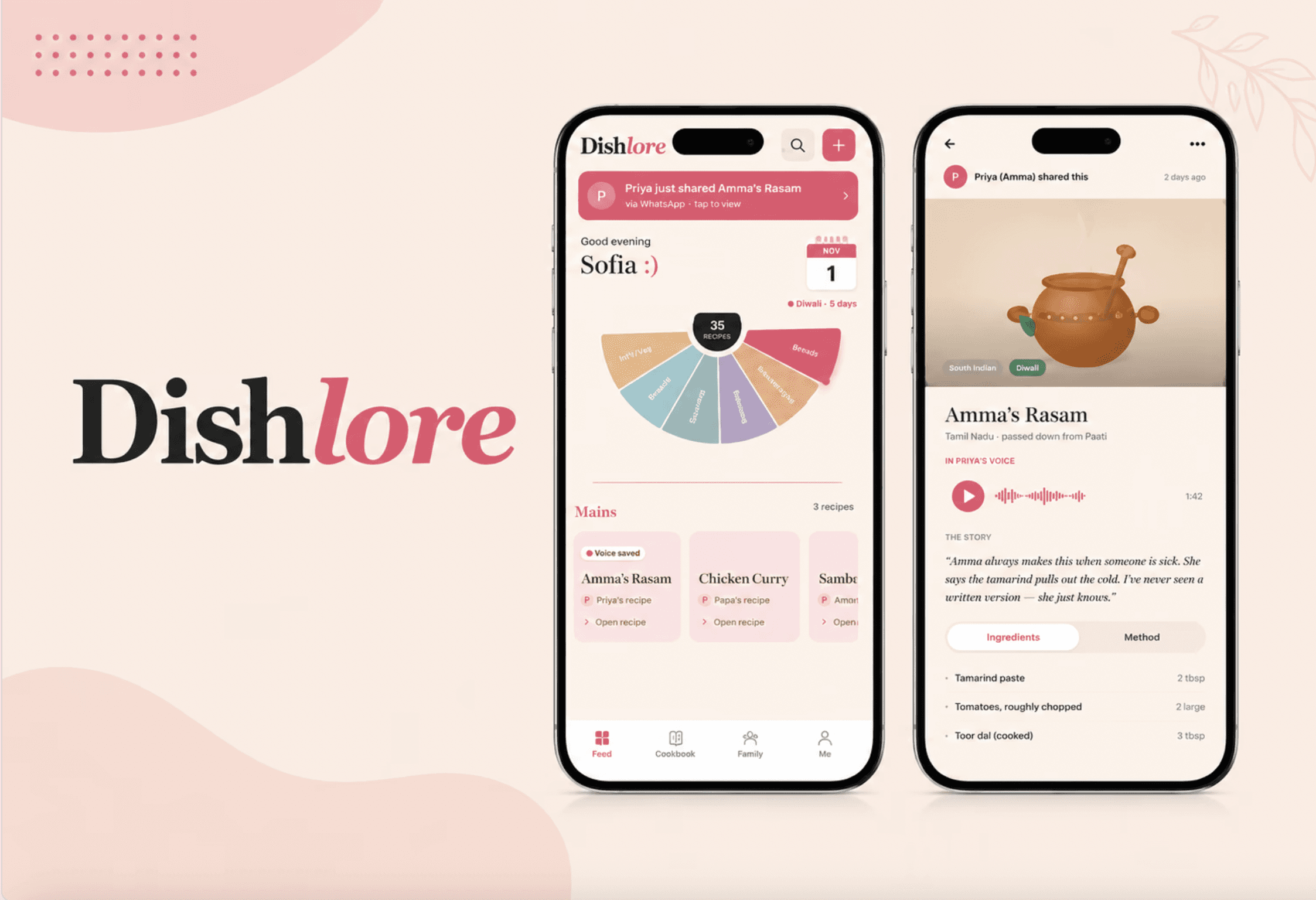
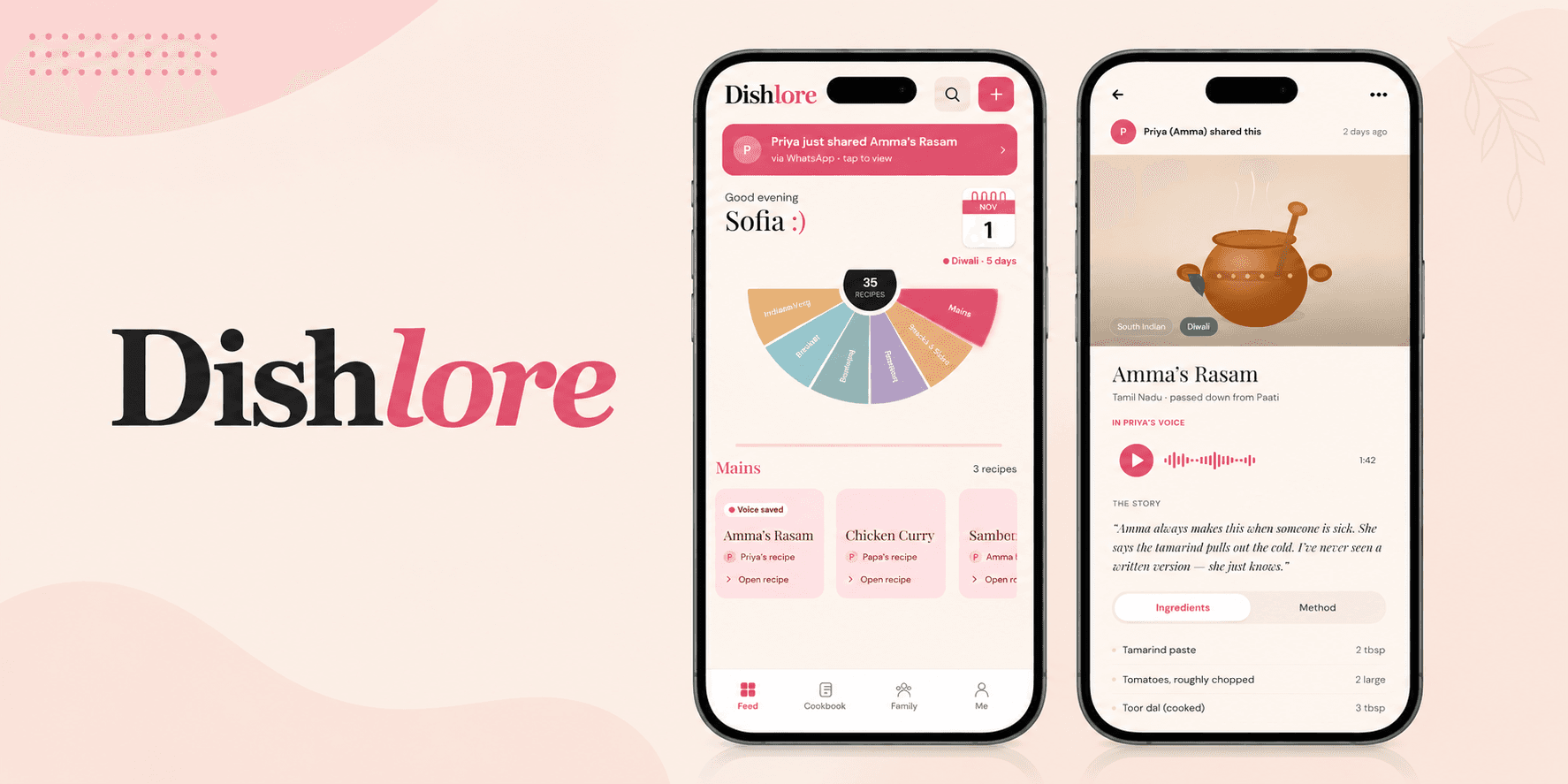
An invite-only family app that captures and preserves the recipes in the original voice of the cook alongside AI-structured instructions and creates space to celebrate them across the family.
The Outcome
A working prototype has been build with distinct features based on user research that is ready to be beta tested.
NYU Capstone
Dishlore was conceptualized and built as my thesis project as part of the M.A. in Learning Technology and Experience Design at NYU. It combined learning theories with UX research and product design to build something for families that celebrates and preserves recipes over generations. It was selected as part of the NYU Leslie Elab Enteprenuership Bootcamp 2025.
Dishlore: an invite-only app for families to celebrate and preserve recipes as cultural heirlooms
Dishlore is an invite-only app for families to save their recipes in different ways, plan family events, and preserve their family's knowledge as cultural heirlooms in one place.
Read the full research report
Features
AI Workflow
Every one of those features rests on a single hard problem: turning what a family already has (a rambling voice note, a photo of a stained recipe card, a forwarded chat) into a clean, shareable recipe without flattening the person behind it. I built an agentic workflow on the Claude API to do exactly that. When someone shares a memory, the system works through four steps:
1
Extracts the recipe content using multimodal AI vision.
2
Structures it into a standardized format: ingredients, steps, and context.
3
Preserves the original voice alongside the structured version.
4
Tags it to the contributor and the cultural or festival context.
Interactive Prototype
Try the actual frontend
This case study is backed by a real, working prototype, not just static mockups. You can interact with the actual frontend interface built on top of the Claude API workflow described above.
Open the interactive prototype →
My Role
The project sits at the intersection of UX, learning design, and product design, and is grounded in learning design theories like dual coding theory and cognitive load theory, and backed by user insights.
How might we enable adults living away from their hometown to maintain emotional connection with extended family by preserving and sharing heirlooms in ways that are effortless, joyful, safe, and sustainable?
Research and Target Audience
I conducted desk research and user interviews with 6 grandparents and a 21-responder quantitative survey to reach a pivotal point: grandparents and the older generation didn't like to use and download apps and preferred using their family chats on FaceTime and WhatsApp.
Insights
Landscape Audit
I audited four leading recipe apps against five dimensions drawn from research: person and family attribution, voice preservation, cultural and festival context, cross-platform capture (especially WhatsApp), and emotional tone. A consistent pattern emerged: existing tools treat recipes as files to organise, not as living artefacts tied to people.
Design Rationale
Each theory translated directly into a product constraint or feature.
Future Directions
Next: integrating multilingual voice translation using Claude's multimodal API, enabling elders to contribute in their native language while the app structures and translates for the wider family.
What I Learned
This was the first project where I had to listen harder than I designed. Every user interview shifted the idea, sometimes radically. The most important reframe came from concept testing: a feature I had been most excited about, the family feed, was the least useful, while a feature I had not designed for, the event space, was the most requested. This was a lesson in prioritizing user-validated features over founder assumptions, a core product management discipline.